Rapid On-Site Erection
Engineered flat-pack container mechanics allow a standard 15 m² drying unit to be assembled on site in under 3 hours, drastically cutting local labor overheads.
1In modern high-stakes construction, oil & gas exploration, tunnel boring, and remote mining operations, workforce welfare and operational continuity are directly linked. Field personnel subjected to torrential rain, freezing temperatures, high humidity, or sub-zero site environments cannot maintain productivity or safety standards if forced to work in damp, saturated workwear and Personal Protective Equipment (PPE). This critical operational bottleneck has driven global procurement managers to prioritize the deployment of engineered Portable Worksite Drying Rooms.
A standard unheated container or basic storage cabin is fundamentally incapable of drying heavy-duty industrial workwear. Without controlled thermodynamic air exchange, humidity rapidly stagnates, leading to bacterial growth, persistent foul odors, fabric breakdown, and severe worker discomfort or hypothermia risks. Purpose-engineered modular drying shelters solve this by integrating high-efficiency heat recovery, targeted multi-channel airflow distribution, high-capacity industrial dehumidification, and heavy-duty structural galvanization.
When B2B buyers evaluate a portable worksite drying room, the primary search query revolves around functional efficiency: "How does a modular drying container eliminate moisture from 30+ wet coveralls and boots overnight without consuming excessive site power?"
To achieve rapid dry cycles—typically 2 to 4 hours for fully saturated gear—the drying facility must balance three physical variables: Thermal Energy Input, Relative Humidity (RH) Suppression, and Volumetric Air Displacement (CFM).
Standard jobsite cabins rely solely on convective space heaters. As water evaporates from wet clothing, the relative humidity inside an unventilated cabin quickly reaches 100% saturation (dew point). At this equilibrium, evaporation completely stops regardless of temperature. Module-T drying rooms utilize forced thermodynamic evacuation: low-wattage PTC heating arrays combined with continuous high-CFM extraction fans and commercial refrigerant dehumidifiers that lower ambient RH below 35%, pulling moisture from thick canvas, leather work boots, and multi-layer thermal suits in a fraction of the time.
| Technical Specification | Standard Modified Storage Cabin | Module-T Portable Drying Room Container |
|---|---|---|
| Structural Integrity | Uninsulated corrugated container; prone to interior rust | CE EN 1090 certified hot-dip galvanized light steel frame |
| Thermal Insulation | None or retrofitted mineral wool (creates thermal bridges) | 40mm–100mm PU/Rockwool sandwich panels (EN 13501-1 Class A1/A2) |
| Drying Time (30 Sets of Wet Gear) | 14–24 hours (high humidity stagnation) | 2–4 hours (dynamic dehumidification & forced air recirculation) |
| Relative Humidity Control | Uncontrolled (RH reaches 90%–100%) | Automated sensor-driven RH suppression (maintained below 35% RH) |
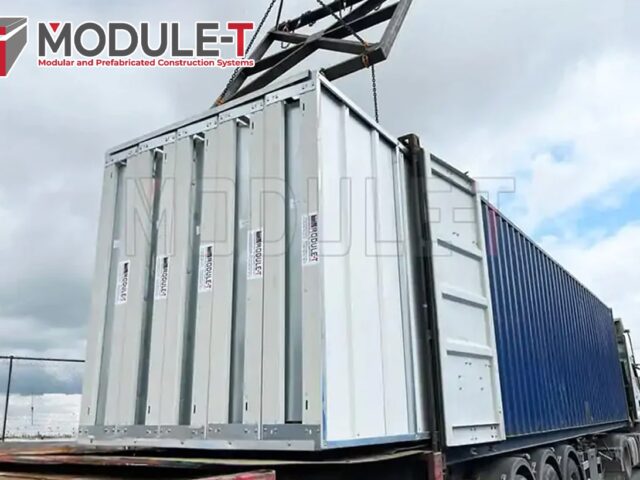
| Logistics & Freight Efficiency | Expensive rigid volume freight (1 unit per truck/container) | Flat-pack packaging system (Up to 10 units per 40ft High Cube container) |
| Electrical & Wet Zone Protection | Basic IP44 surface wiring | Fully recessed IP65 waterproof conduits, breakers, and LED fixtures |
| On-Site Assembly Time | Requires crane lift of heavy rigid structures | 2 workers complete full assembly in 2–3 hours with standard tools |
Module-T engineers and manufactures a diverse portfolio of portable drying containers and modular site welfare buildings customizable to your headcount, geographic location, and logistics limits. Below are our most requested standard configurations recommended for global project procurement:
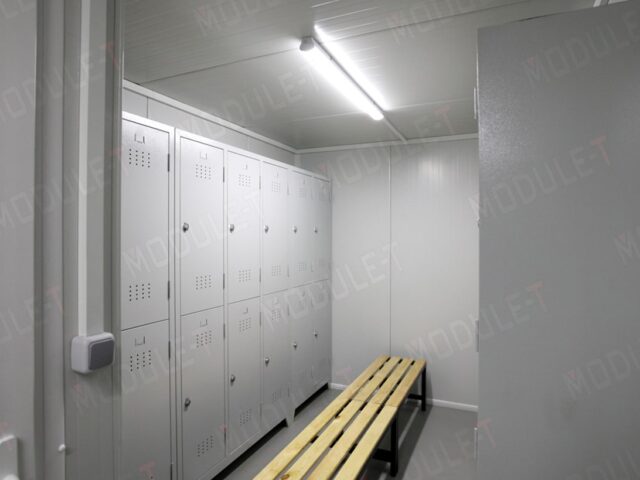
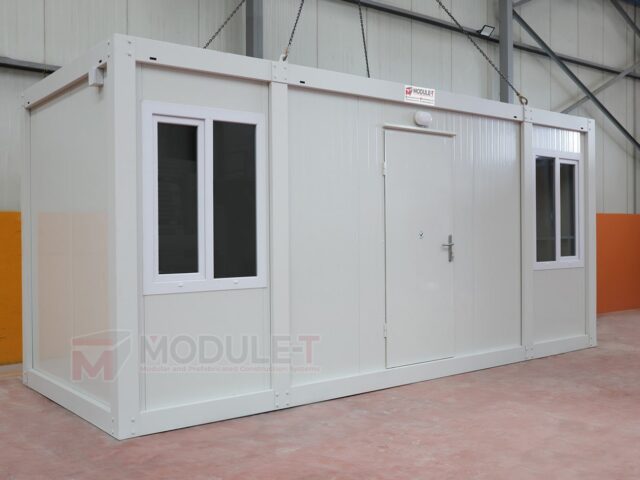
As international construction contractors, ESG compliance auditors, and mining syndicates upgrade their project site standards, the procurement strategy for site welfare assets is undergoing a rapid evolution. The key procurement trends reshaping the market over the next decade include:
Remote project sites relying on diesel generators face mounting fuel costs and strict carbon emission limits. Next-generation portable drying rooms incorporate roof-mounted solar photovoltaic array interfaces paired with variable-refrigerant-flow (VRF) heat pumps. This hybrid approach reduces generator load by up to 60% during peak daytime operating hours while preserving night-shift drying capabilities.
Procurement teams are shifting away from single-use timber sheds or low-cost disposable structures in favor of demountable, highly durable assets. Module-T's flat-pack structural framework allows a drying room container to be assembled on Site A, operated for 24 months, fully dismantled into compact flat packages, shipped across borders, and reassembled on Site B with zero structural degradation.
Global labor regulations (including EU Health & Safety directives and OSHA guidelines) increasingly mandate that contractors provide clean, hygienic, and sanitized environments for changing and drying work clothes. Prolonged exposure to damp workwear is directly linked to skin infections, respiratory illness, and increased absenteeism. Investing in high-efficiency worksite drying facilities is now recognized as a direct driver of project uptime and labor retention.
Technological advancement in modular construction is moving beyond simple structural assembly into intelligent environment management. Key technological developments integrated into modern portable worksite drying rooms include:
Modern drying rooms feature smart PLC controllers equipped with ambient moisture sensors. Instead of running heaters continuously on timers—wasting valuable power—the system automatically ramps down heat and airflow once internal relative humidity reaches target dry thresholds (e.g., 30% RH), sending real-time operational status updates to site management software.
High-volume drying shelters present hygiene risks if moisture remains trapped in porous surfaces. Modern modular units utilize smooth, non-porous pre-painted galvanized steel panels treated with anti-microbial coatings. Interior floorings feature heavy-duty seam-welded vinyl or sloped aluminum checker plate flooring with integrated perimeter gutters for easy wash-down and chemical disinfection.
Module-T is recognized as a premier global manufacturer of modular containers, flat-pack buildings, and prefabricated site accommodations. Operating from state-of-the-art Turkish manufacturing facilities, Module-T delivers certified, high-precision engineering backed by over 15 years of industry leadership across 6 continents and 120+ countries.
When you partner with Module-T for your portable worksite drying room requirements, you gain direct access to our core enterprise capabilities:
Module-T Manufacturing Advantage
Six core operational advantages that make Module-T the preferred partner for international project site infrastructure.
Engineered flat-pack container mechanics allow a standard 15 m² drying unit to be assembled on site in under 3 hours, drastically cutting local labor overheads.
1
Built from high-grade galvanized pre-painted steel profiles with certified thermal sandwich panels for total corrosion resistance and structural endurance.
2
Custom interior benching, specialized high-CFM HVAC integration, IP65 electrical circuits, and layout options customized to your exact site layout.
3
Our flat-pack transport packaging optimizes sea container volume, shipping up to 10 modular units in a single 40ft HC container worldwide.
4
Automated manufacturing schedules ensure reliable lead times and transparent shipping dispatch for critical project mobilization deadlines.
5
Comprehensive assembly documentation, step-by-step videos, and dedicated technical supervisor dispatch services available for global installations.
6B2B Procurement FAQ
Expert technical answers regarding portable worksite drying rooms, modular container logistics, and site installation specifications.
For a site crew of 20 to 30 workers, we recommend a 30 m² modular container unit (or two linked 15 m² flat-pack containers). This configuration provides ample linear space for 30 heavy-duty clothing hangers, 30 boot dryer pegs, integrated changing benches, central drainage, and dual industrial dehumidifiers without causing gear overcrowding.
All internal electrical installations inside Module-T drying rooms use IP65 waterproof-rated light fixtures, enclosed PVC conduit wiring, sealed moisture-proof sockets, and dedicated residual current circuit breakers (RCCB). Heating elements are shielded to prevent direct contact with dripping water or damp fabrics.
A standard 20ft (15 m²) Module-T drying room container equipped with a 2kW PTC heater array, 1.5kW commercial dehumidifier, and high-efficiency extraction fan typically requires a single-phase 220V–240V / 50Hz or 60Hz power supply with a 20A dedicated breaker. Custom 3-phase 380V–440V configurations are available upon request for heavy industrial sites.
Yes. Module-T drying containers are designed with reinforced galvanized steel corner castings and forklift pockets. Fully assembled units can be lifted by crane or forklift onto flatbed trucks and moved across site sectors as project phases progress. For long-distance inter-project shipping, units can be disassembled back into compact flat packs.
Module-T drying rooms feature a sloped aluminum checker plate floor or heavy-duty welded PVC floor pan with integrated perimeter drainage channels. Water dripping from wet gear collects in the channels and drains out through external floor outlets that can be connected directly to your site’s wastewater network or collection tank.
For extreme cold weather environments (sub-zero or Arctic sites down to -40°C), we recommend 80mm to 100mm Polyurethane (PU) or Rockwool sandwich panels. This provides maximum thermal resistance (low U-value), eliminates condensation formation on interior metal surfaces, and minimizes heat loss during door openings.
You can request full technical catalogs, structural CAD drawings, and factory-direct price estimates by clicking the Get Catalog button on this page, or by contacting our engineering sales team directly via email at [email protected]. Our team typically responds within 24 hours with complete project proposals.
Yes. Our sandwich panel wall and ceiling core materials are engineered to comply with EN 13501-1 fire rating standards (Class A1/A2 non-combustible options available with Rockwool cores). Automatic thermal cutoff switches prevent heater overheating, ensuring safe, continuous 24/7 overnight operation without supervision.
Direct Procurement Contact
Barthstraße 2–10, 80339 München, Deutschland
[email protected] +49 89 2017 411386–90 Paul Street, EC2A 4NE, London, United Kingdom
[email protected] +44 7868 291 260Submit your project requirements to receive comprehensive engineering specs, floor plan proposals, and FOB/CIF shipping quotes directly from our manufacturing engineering team.