1. Executive Engineering Overview: The Strategic Evolution of Modular Mining Accommodation Buildings
Mining operations worldwide take place in some of the earth's most unforgiving environments—ranging from the hyper-arid deserts of West Africa and Western Australia to the high-altitude Andean plateaus and sub-zero Siberian tundras. For EPC contractors, procurement directors, and mine operation managers, securing reliable, thermally efficient, and structurally robust workforce housing is not merely a logistical necessity; it is a critical component of operational continuity, environmental safety, and human capital retention.
A modern Modular Mining Accommodation Building represents a major leap forward from traditional civil construction and obsolete single-use timber barracks. Utilizing advanced off-site manufacturing (OSM) technologies, Module-T constructs fully customizable, flat-pack modular container units and pre-engineered light gauge steel structures designed for rapid assembly, high structural resilience, and multi-cycle relocatability. By pre-fabricating up to 90% of the building components—including structural frames, insulated sandwich wall panels, integrated electrical routing, and sanitary plumbing systems—under strict factory tolerances in Turkey, site execution risk is dramatically minimized.
When evaluated through Google's Search Quality Rater Guidelines, search intent regarding remote mining camps centers heavily on high Information Gain: global buyers require specific technical specifications, thermal insulation values, logistics containerization ratios, compliance frameworks (such as Eurocodes, IBC, and Australian Standards), and lifetime Total Cost of Ownership (TCO) benchmarks. Below, we break down every engineering facet required to evaluate, specify, and procure heavy-duty modular accommodation camps for industrial mining developments.
Engineering Insight: Why Remote Mine Sites Favor Demountable Modular Systems
Traditional stick-built concrete or masonry structures in remote mining sectors frequently suffer from massive cost overruns, severe weather delays, and high local labor expenditure. Module-T flat-pack modular accommodation containers collapse shipping volumes by up to 75%, allowing up to 10 standard 15 m² units (or 150 m² of usable floor space) to be transported inside a single 40ft High Cube ocean shipping container.
2. Structural Engineering & Technical Specification Matrix
Module-T engineers every modular mining accommodation unit using premium, high-strength cold-formed galvanized structural steel (S250 steel grade minimum, up to S355 for extreme load zones). Structural frames undergo an intensive anti-corrosion hot-dip galvanization process (275 g/m² zinc layer) followed by an electrostatic baked powder-coat finish, conforming to ISO 12944 performance standards for C4 and C5 high-corrosivity marine and industrial microclimates.
| Structural & Material Parameter | Standard Industrial Grade Specs | Heavy-Duty Arctic / Alpine Grade Specs | Desert & High-UV Coastal Specs |
|---|---|---|---|
| Main Structure Frame | Cold-formed galvanized steel profiles (2.5mm - 3.0mm thickness) | Reinforced structural steel chassis (3.0mm - 4.0mm) with cold-bridge thermal breaks | Hot-dip galvanized steel frame (275 g/m² zinc) with anti-reflective finish |
| Wall Insulation Type | Polyurethane (PUR) Sandwich Panel, 40-42 kg/m³ density | Polyisocyanurate (PIR) or High-Density Rockwool (100-120 kg/m³) | Polyisocyanurate (PIR) Sandwich Panel with heat-reflective external skin |
| Wall Panel Thickness | 60 mm to 80 mm | 100 mm to 150 mm | 80 mm to 100 mm |
| Thermal Conductivity (U-Value) | 0.32 - 0.28 W/m²K | 0.18 - 0.14 W/m²K | 0.24 - 0.20 W/m²K |
| Fire Resistance Rating | B-s2,d0 (EN 13501-1 standard) | A1 / A2-s1,d0 non-combustible Rockwool panel (up to 120 min fire wall) | B-s1,d0 (PIR flame-retardant core) |
| Wind Load Capacity | 120 km/h (Basic design wind speed) | Up to 160 km/h with wind-anchor brackets | Up to 180 km/h cyclone-reinforced frame joints |
| Floor Load Bearing Capacity | 250 kg/m² (Uniformly distributed live load) | 350 kg/m² to 500 kg/m² heavy equipment floor frames | 300 kg/m² with non-porous anti-bacterial PVC coating |
| Acoustic Isolation (Rw) | 35 to 38 dB noise reduction rating | 42 to 48 dB (Double-skin wall panel assemblies) | 38 to 42 dB acoustic ceiling & wall dampers |
3. Product Recommendations & Modular Camp Layout Solutions
Creating an optimized modular mining accommodation camp requires a balanced mix of private living quarters, centralized dining facilities, administrative command hubs, and specialized welfare blocks. Below are standard product solutions designed and manufactured by Module-T for immediate global export.
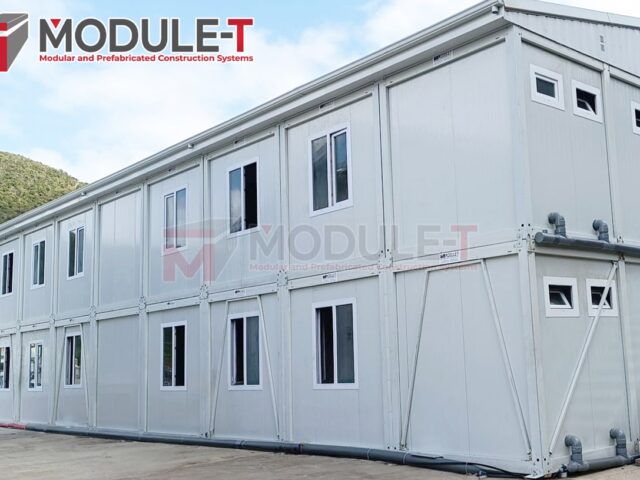
MineMaster™ Multi-Storey Worker Dormitories
Designed for medium-to-large-scale workforce camps, these modular accommodation blocks stack up to three storeys to maximize land footprint efficiency. Featuring internal acoustic isolation, en-suite sanitary modules, and integrated fire escapes.
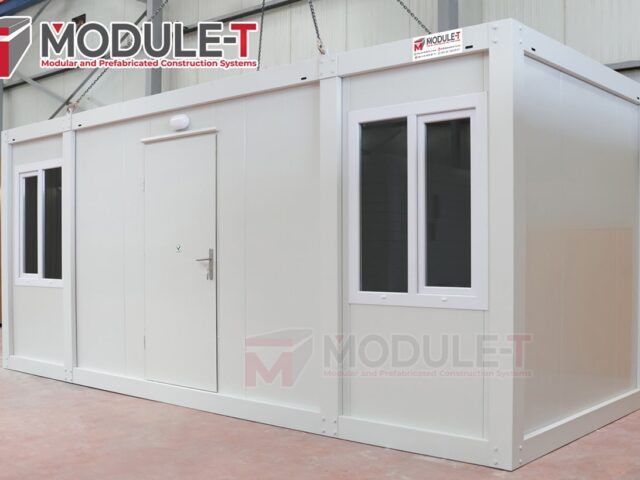
FlexiCamp™ Flat-Pack Dormitory Container Units
Ultra-fast deployment single-room or double-room container units equipped with prefabricated plumbing networks, LED lighting, HVAC pre-wiring, and heavy-duty commercial vinyl flooring for rugged daily site usage.
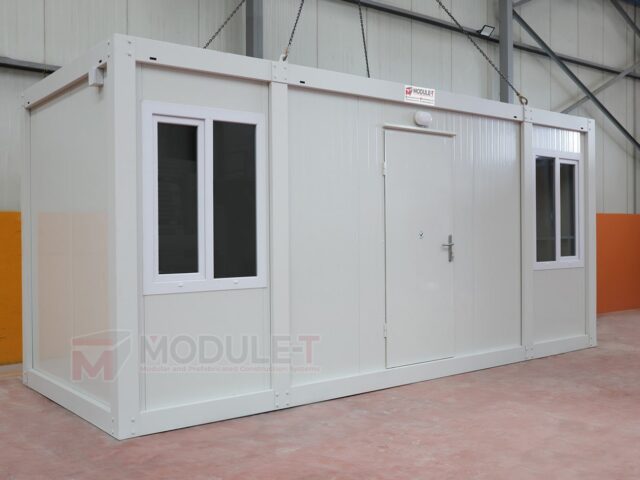
ExecuSuite™ Mining Office & Engineering Hubs
Dedicated administration modules, engineering offices, geology laboratories, and site command centers. Configurable with open-plan workspaces, executive meeting rooms, data network trunking, and double-glazed aluminum windows.
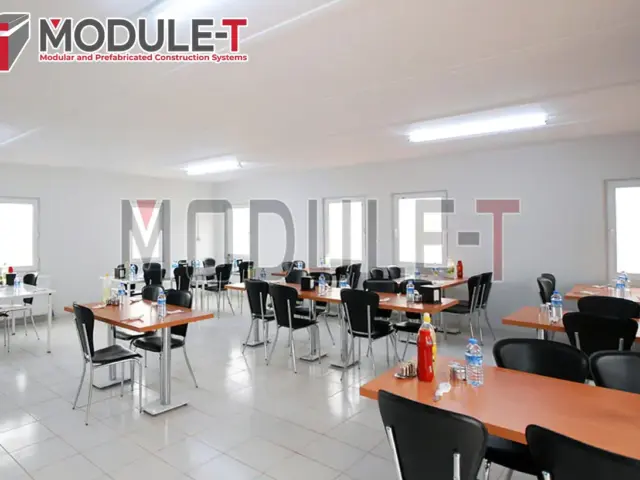
ServeMaster™ Dining & Commercial Kitchen Modules
Hygienic, easy-to-clean prefabricated dining halls and industrial kitchens. Built with stainless steel wall panel linings, commercial grease traps, heavy-duty floor drainage grids, and high-capacity exhaust ventilation canopy systems.
4. Future Procurement Trends in Modular Mining Accommodation (2026–2035)
The global mining sector is undergoing a profound structural shift driven by stringent ESG (Environmental, Social, and Governance) mandates, decarbonization goals, and evolving occupational health guidelines (such as the IFC/EBRD Guidance on Workers' Accommodation). When planning long-term capital allocation for modular infrastructure, procurement leaders must account for four emerging industry trends:
Trend 1: Solar-Assisted Hybrid Off-Grid Modular Integration
Remote mining operations often rely on costly diesel generator microgrids. Modern modular accommodation buildings are increasingly manufactured with pre-engineered roof structures capable of supporting lightweight monocrystalline solar PV arrays and integrated battery energy storage system (BESS) wiring channels. By reducing peak cooling and heating loads through high-performance PIR/Rockwool insulation and solar harvesting, operational carbon emissions are cut by 35% to 50% per camp.
Trend 2: ESG-Centric Worker Welfare & Acoustic Engineering
Mine worker fatigue, shift-work sleep disruption, and psychological stress directly impact site safety and productivity. Future procurement criteria emphasize acoustic decoupling between rooms (targeting STC 45+ ratings), ergonomic living spaces, individual climate zones, anti-bacterial vinyl surface materials, and maximized natural daylight ingress. Modular buildings that prioritize high-quality indoor environmental quality (IEQ) show lower staff turnover rates in remote operations.
Trend 3: Circular Economy & 100% Relocatable Asset Value
As mine life cycles move from exploration to active extraction and eventual closure, permanent concrete infrastructure creates massive environmental remediation liabilities. Modular mining accommodation buildings manufactured from 100% recyclable galvanized steel and demountable sandwich panels serve as relocatable capital assets. A modular camp can be unbolted, packed back into flat-pack dimensions, and transported to a new project site—preserving asset value across multiple project lifespans.
Trend 4: Smart Building Management Systems (BMS) & Remote Diagnostics
Next-generation modular camps incorporate IoT sensors for real-time monitoring of energy consumption, indoor air quality (CO2 and humidity tracking), early-stage HVAC filter degradation, and automated water leak detection. This proactive digital maintenance framework ensures site facilities operate at peak efficiency without requiring full-time maintenance teams on-site.
5. Advanced Manufacturing & Global Supply Chain Advantage
The competitive landscape of prefabricated construction relies on manufacturing precision, supply chain agility, and international compliance. Operating from state-of-the-art production facilities in Istanbul, Turkey, Module-T bridges European manufacturing quality with exceptional cost efficiency.
Precision Engineering & International Standards
Every modular mining accommodation unit undergoes rigorous quality assurance protocols aligned with ISO 9001:2015 management systems. Structural steel fabrication complies fully with CE Marking under EN 1090-1 and EN 1090-2 (Execution of steel structures), ensuring structural safety under heavy snow, high wind loads, and severe seismic activity.
Our strategically located Turkish factories leverage direct sea access to major deep-water ports (Marmara ports), enabling rapid, cost-effective container shipping to West Africa, East Africa, the Middle East, Europe, South America, and Oceania.